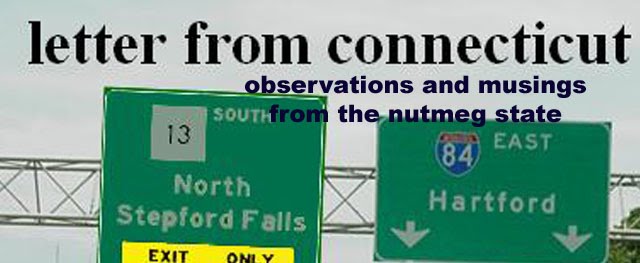
"It could be a few cold, dark days to come in North Stepford Falls."
- Me, Oct. 29, 2011
If only that were true. That would have been easy compared with what really happened.
Saturday, the power went out at about 2:30, just as some dude was about to sell us double-pane replacement windows (which we do need).
It took all of about 90 minutes for enough wet snow to fall on the trees, most of them full of leaves, to start cracking and falling.
When a tree falls in the forest and no one is around, it most definitely does make a sound. And when branches and limbs snap and tumble, the sound is like a rifle going off --crack! -- and then the rush of leaves through the air as it falls to the earth.
There were so many limbs snapping, it sounded like a rifle range.
We lit candles and fetched our storm preparedness goods -- which had gone largely unused during Irene -- and watched darkness slowly fall upon the neighborhood, with no lights anywhere to fend it off.
And then we happened to be looking out the kitchen window when a tree in the back lot went down.
A sick feeling washed over me. True, in the spring, we had cut down four or so trees that were threatening the house -- including one that hung over the house and definitely would have caused major, serious damage. But there were still lots of trees around the house. And any number of them falling could be a catastrophe.
I put on my bike helmet -- how ridiculous is that? -- and ran outside to start the generator. No more second guesses about that purchase. So at least the fridge and a space heater were running.
With no other alternatives and too scared to sleep upstairs should a tree truly come crashing down upon us, we all camped out in the living room: Me and Sofia on the lumpy futon on the floor, Michelle in her barcalounger.
But I barely slept at all. Because it was so quiet and dark (except when trees fell), any noise or light grabbed my attention. I saw the beams of light across the street from our neighbors inspecting the tree damage. I wondered if someone would try to steal our generator.
At about 4:30, the generator went off. I ran outside as a fresh band of snow had come along, and the trees were falling again. I could swear I heard one cracking over my head as I poured gasoline into the generator. I did that as long as I had the nerve to stay there, and then when i was done, i pulled the starter and sprinted back into the bulkhead.
Back under the covers, I did three laps of my grandfather's rosary.
When the light came, I awoke -- having had about 2-3 hours sleep -- and went outside to see what had happened.
Destruction.
The treetops that were still standing in the neighborhood were weighed down with wet snow. Those that weren't were on the ground -- many on top of the power lines they had pulled down, others resting on the lines like some naturalistic Alexander Calder mobile.
There were two or three treetops in our driveway, too big to pull to the side. They'd have to be sawed apart if I wanted to shovel the driveway -- or leave. Not that I imagined there was any businesses open anywhere.
There were treetops down all over the property, to the right and the left of the house. Part of a tree had landed between our house and the vacant house to the south and it took hours for me to realize where it had come from.
I am usually not one to talk about my faith in public; it's my business and not my place to preach. But looking at the branches down everywhere but on our house or our utility supply lines or our cars, and seeing trees scattered through yards and on wires up and down the street, I realized my desperate laps around the rosary, in which I begged for protection for my family, had been heard. Believe what you like; I know what I know. And what I knew was I needed to count blessings.
We had no electricity or hot water. The house was about 59 degrees, but felt cooler. Nothing to do but work.
I boiled some water on the side burner of the gas grill and got sawing. My boots and gloves soon became waterlogged; I put on work gloves underneath and they soaked through, too. (Three days later, those gloves were still waterlogged; wet things don't dry in 50-degree temperatures, even when they're next to a space heater.
I thought about the woodsmen who had labored so hard in northern New Hampshire, where I used to work, Back In The Day. I looked like one, too, in my plaid woolen jacket. Sawing and hauling by hand was hard work and by the time the driveway had been plowed, I was exhausted and sore.
A cold sandwich and a hot cup of tea was my reward. I would have loved a hot shower, but that wasn't going to happen anytime soon.
I ventured out in search of gasoline, hoping that the BJs two towns over would have some. I came upon two traffic jams, each a good quarter-mile from gas stations that were still open.Luckily, the wait was not long at BJs and I came home with a new space heater and a new, working carbon monoxide monitor in case we got desperate enough to use the fireplace. (It's too shallow to really be of any use heating the house; what it does do well is make the living room smell like a barbecue pit, which seems ideal until it does so for two weeks.)
Driving around showed me something else: Just how much damage there was for miles and miles around. State roads had been reduced to slalom courses; side roads were closed. Trees were down across roads, on wires, or had just missed houses.
In our neighborhood, trees had hauled power lines right off the houses or ripped them from the utility poles. It would be days before our grid was fixed, and no one had seen a CL&P truck anywhere, or even a rumor of one.
When they said power would be out for days as a result of the damage from this storm, this is what they meant -- and I realized that it could be a solid week or more before the electricity came back.
When night fell, we went to bed in the living room once more and hooked up the generator to the fridge and the space heater.
Monday came and I got another five gallons of gas at BJ's in the morning. At 10:30 I set off for work and proceeded directly to the gym, where I would get my first hot shower in three days. I had no idea how much I appreciated indoor plumbing and available hot water; it was as much an emotional release as it was invigorating to have hot water and soap on my skin and feel and smell clean afterwards.
That afternoon, we got word that school was going to likely be canceled the rest of the week, and so my wife and daughter bagged up their things and headed north to the Berkshires, which got way more snow but somehow had electricity. I didn't want to send them away, but it made no sense for them to stay here and freeze for my benefit.
I came home after work and instead of going to my friend's house, I bundled up in a sleeping bag and comforter, turned on the space heater and went to sleep.
When I awoke, the house was 54 degrees and I could see my own breath. And as I tried to get warm, I realized a few things:
_ There was no way I could keep the house warm.
_ Spending 90 minutes to two hours daily getting gasoline was a poor use of time and resources, considering that it could not keep the house warm.
_ It was cold, dark and lonely here.
So I abandoned ship. For the next four nights, I slept at my friend Matt's house (they never lost power), coming back to check on the cat, clean out the fridge and freezer (good thing we didn't spring for the "big buy" of filet mignon) and see how cold it was inside.
Roberto the $40 free guppy (he was free from school; the stuff for him to live with was $40) made it to Wednesday. He now sleeps with the fishes.
By Friday it was 49 degrees and warmer outside than it was inside. That was lucky. If there had been a sudden cold snap, I would have needed to drain the heating system -- which, as I learned, is not as easy as it sounds.
And by Friday, there was serious mental strain to go around.
And as the Nutmeg State gradually turned the lights back on, North Stepford Falls remained in the dark. On CL&P's color-coded map of ineptitude, my town remained in the black -- 90 percent of customers or more without power. And every night, I would pass the lit-up streets of the neighboring town, then turn left to head home -- and into the darkness. That left-hand turn and drive back home became more and more depressing as the week ground on.
The CEO of the company was being raked over the coals at every news conference and it didn't matter. The town selectmen held a news conference to essentially say "CL&P sucks' and it didn't matter. And what could they do, really? Could they have done a better job preparing? Maybe had some storm crews on call? Sure, but with this level of damage, it still would have been days.
And it's worth noting here that a couple weeks before the storm, a report in the Courant said according to a study, a Category 3 hurricane would devastate Connecticut. That's a lot easier to understand now. And scary.
As for me: It was like being back in Maine and New Hampshire: It was pitch-dark at night and I was technically homeless and living on my friends' couches. At least I wasn't earning $17,000 a year anymore. There was another similarity -- no wife, no kid. I don't do so well for long stretches without them. And I could hear the strain in my wife's voice over the phone.
The statement "We have no power" never meant more. If you want to get picky about it, the more precise phrase would be "We have no electricity." But both were true. In this situation, there was nothing anyone could do but wait. Even if you had many useful resources at your disposal, as we did. And that feeling of powerlessness -- the sense that my life is not normal and I don't know when it's going to be normal again -- brings depression and anxiety with it. Even if you know that in the grand scheme of things, you got off easy. (And we did.)
Saturday, I was home to try to get some work done around the place when I saw my first utility truck. That's a full WEEK, friends. They were from South Carolina. So we couldn't even get a repair crew from the United States of America. It turns out they had been in the neighborhood for two days -- just not where we could see them, but along the transmission right-of-way, trying to put the grid back together.
Despite being from a place that once declared war on the United States and bombed a U.S. Army fort, they were nice enough to be straight with us. CL&P had unwisely promised that 99 percent of North Stepford Falls would be back on the grid by midnight on Sunday, but the foreman for our foreign utility workers told us "I'm not sure we'll have your power back by midnight." And they were upfront and told us at 2 p.m. that they had suddenly been ordered off the job and ordered to report somewhere else. (They did come back.)
And bad as it was, they said they usually saw much more extensive damage to the grid in their part of the world -- which, after all, sees hurricanes. "There's usually nothing left. Usually we'd be coming through with bulldozers, clearing everything out and putting up new poles and wires."
I asked one more question: Tigers (Clemson) or Gamecocks (U. of South Carolina)?
"GAMECOCKS," came the forceful reply. So that detail was settled.
Around this time, my friend Matt came over and helped saw apart and stack some of the insane amount of fallen treetops in the yard and the back 40 to the street for eventual disposal/chipping. (Note: despite the town saying this was going to happen, it hasn't yet.)
At 3:30 I headed out of the neighborhood to go to church. There were at least five utility trucks trying to reassemble the neighborhood power grid, which lifted my spirits.
It took another two days for the power to be restored. TEN DAYS without electricity or hot water in the house. And eight of those days without my wife and daughter.
But by that point, I knew it was finally an eventuality. And really, it was a minor crisis, truth be told, albeit a really inconvenient and draining minor crisis. And I was already aware, as I drove to Hartford, that it was going to be over soon, that it had brought people together and strengthened friendships. At work, the only question you heard anyone ask was "got power?" And depending on the answer, you heard offers of food and shelter and words of support.
So the blessings were not limited to keeping trees off my roof; really, in spite of the darkness, cold, isolation and depression that comes with wondering when everything is going to be normal again, they were everywhere.

No comments:
Post a Comment