I've been thinking about grudges and forgiveness -- seeking it and giving it.
A couple of weeks ago, Jack Tatum died. For those who don't know: Tatum was a defensive safety for the Oakland Raiders in the 1970s. He was one of the hardest and most feared hitters in the game. But a play in a meaningless preseason game changed his life and how he would be remembered.
On Aug. 12, 1978 in Oakland, Patriots wide receiver Darryl Stingley came over the middle on a crossing pattern. He went for the ball; Tatum went for Stingley.
But Stingley didn't get up. He was paralyzed from the chest down and spent the rest of his life in a wheelchair.
It was, by the rules of the game, a clean hit; no flag was thrown and no fines or admonitions from Pete Rozelle followed.
Tatum never apologized or contacted Stingley to show any remorse for what had happened. By his own reckoning, it was a clean hit in a violent game and he had done nothing wrong.
"It could have happened to anybody," Tatum once said. "People are always saying, 'He didn't apologize.' I don't think I did anything wrong that I need to apologize for. It was a clean hit."
Still, Tatum wrote an autobiography when his career was over titled "They Call Me Assassin," playing up his tough-guy image. Two more books along the same lines followed. And he never talked to Stingley about what happened between Aug. 12, 1978 and April 5, 2007, when Stingley died.
But life after football wasn't good for Tatum. He lost one leg at the knee and the toes on the other to diabetes. And he was remembered not as one of the all-time greats, part of the Raiders "Soul Patrol" defensive backfield and one the most feared defensive backs to ever play the game, but as the guy whose hit paralyzed Darryl Stingley in a game that didn't even count.
Tatum's coach, John Madden, was deeply shaken by the incident and visited Stingley in the hospital regularly. He told his players that from that moment on, they should think of him as a Raider. And Stingley wrote in his autobiography that he was convinced what happened to him contributed to Madden's decision to abruptly leave coaching while he was on top.
Tatum didn't exactly treat Stingley like a Raider. He never reached out. Never expressed regret, even if it might not have been his fault. Never lost the tough guy facade. He was just playing football. He'd done nothing wrong.
But Madden knew better.
"He never talked about things, and you couldn’t get him to talk about it," Madden told the Los Angeles Times after Tatum died. "It was something that ate on him for his whole life."
On performance alone, Jack Tatum should probably be in the Pro Football Hall of Fame. But even in a game where big hits are celebrated and replayed endlessly in highlight reels, Tatum's role in one of the sport's ugliest moments left him a pariah. In a sport that glorifies violence, he was just too violent. He did what he was supposed to do and did it too well. And in a society that demands apologies from the heroes it builds up and knocks down, his lack of regret in the aftermath broke an unwritten rule.
At the time and for a long time, I hated Jack Tatum for refusing to apologize – what kind of monster puts someone in a wheelchair, on purpose or not, and won't even say he's sorry? I hated that he capitalized financially on it by writing a book. I hated that on an incomplete pass in a meaningless preseason game, he lined up and laid out a defenseless receiver.
So when Steve Grogan, when asked if he could say anything nice about Jack Tatum, said "I just can't do it," I understood.
"I have a hard time trying to find something nice to say," Grogan told ESPN.com. "That bothers me because I'm not like that normally. You may talk to guys that played with him, and they might tell you he was greatest teammate in the world and everybody loved him.
"The circumstance that we were involved with, just the way he handled it, that will never come out of any of our mouths or minds."
But Darryl Stingley forgave Jack Tatum. Even though Tatum never reached out.
"It's hard to articulate," Stingley said in 2003, according to The Boston Globe. "It was a test of my faith. The entire story. In who, and how much, do you believe, Darryl? In my heart and in my mind I forgave Jack Tatum a long time ago."
I thought about all this a couple of days later, when a judge on Connecticut rejected a motion by one of the two "men" accused of three murders in a brutal home invasion to remove the death penalty as a possible punishment for his crimes.
Those two "men" terrorized, sexually assaulted and killed a woman and two girls in the midst of their bid to steal the family's savings. Their unspeakable and violent crimes truly terrified and horrified the entire state and left a good man with only memories of his wife and daughters – and nightmares of how they were tortured and murdered after his attempts to defend his family were overpowered.
When I saw that news, I thought, "Good."
I'm not for capital punishment in most cases; I don't believe it to be an effective deterrent or a means to closure. And there's no wiggle room in "Thou shalt not kill" – it means what it says. Yet I have not for a second felt any pangs of regret that those two "men" will likely put to death by the State of Connecicut when they're found guilty as charged, because they went so far beyond the pale of human decency.
That's admittedly a double standard. Executions are bad but some are OK when you think they really deserve it? Yeah, not my clearest, most logical thinking.
But if Darryl Stingley could forgive the man whose hit took away the use of his legs the last 29 years of his life ... well, if he can forgive, shouldn't anyone be able to forgive? Or is there a line beyond which we can forget about forgiveness and seek revenge with impunity? Can even people who seem beyond redemption and repair, like the two facing execution for home invasion, rape and murder, be forgiven?
That's a big question and a bigger challenge.
I've seen the harm grudges can do, first-hand. I must admit that I've held a few, too. And I've been thinking that maybe it's time those grudges got let go.
And not because Darryl Stingley forgave, but because Jack Tatum didn't ask.
Let me explain.
Jack Tatum was probably not the monster he was made out to be, by the media or, somewhat unwisely, by himself. In the blink of an eye, he made a decision informed by years of practice and training at the highest level of his profession – he saw the ball, he saw the receiver, he made a play.
Football players all live with the possibility that every time they step on the field, they might not walk off. And yet they have to put that out of their minds in order to play at the highest level. It's why you see huge men who could bench press a city bus drop to their knees and pray when a member of their warrior society – even on an opposing team – goes down with what could be a spinal cord injury. It's also why they go right back out there and start hitting each other again after the injured player is taken off the field.
It's the cognitive dissonance inherent in the game. If you have to stop and think about making a play because you're scared you might get hurt or hurt someone else, you can't make the play fast enough. And in that case, you're done as a pro and can only hope you cracked open a book in your five years at State U.
So players act tough and they talk about serious injuries in measured tones, but not very often, because to acknowledge the wheelchair in the room or the EMTs on the sidelines is to acknowledge they are there and why.
I don't think it's a great logical leap to suppose Jack Tatum's apparent lack of empathy for Darryl Stingley had everything to do with that. If I can't be tough, I can't play this game. So I've gotta be even harder. Maybe call myself "assassin," even if no one ever called me that.
Thing was, even if it wasn't his fault, it was a preseason game and a man never walked again. There was ample time for him to put aside the game's macho bravado and the Raider mystique for a moment and embrace humanity – his own and Stingley's. He didn't even have to apologize if he truly believed that it wasn't his fault; "I'm sorry that this happened to you, I never meant for it to happen" would have been enough. And he simply wouldn't or couldn't do it.
So when he lost one leg at the knee and five toes on the other? The medical science says that's diabetes. But I see a metaphor there. I see the anger he built up to make himself an even harder competitor, the feelings he wouldn't talk about after the Stingley play, literally consuming him. Again, as Madden said, "It was something that ate on him for his whole life."
In the gospels, Jesus tells us to forgive. He tells us to love our enemies and to forgive not 7 times but 7 times 70. He accepts the cross and forgives his executioners. It's not offered as an optional exercise; it's what we're asked to do.
Jesus also tells us in the gospels that by seeking forgiveness, we set ourselves free. But Jesus doesn't say "only forgive those who ask." He tells us to turn the other cheek and when they take your cloak, give them your coat, too. It's one of the most pervasive themes in the gospels - and maybe the hardest for humans to heed, given our continuing penchant for shunning, hating and killing each other for slights real and imagined.
So what about those grudges? Can I learn anything from any of this? Maybe fall a little less short of that standard?
It would be poetic if I sat here and said "I've decided to let everyone off the hook who really hurt me or a friend." It would also be a lie. I'm just not there yet.
But Jack Tatum, of all people, has me thinking about it.
Sunday, August 15, 2010

Friday, August 13, 2010
A Modest Proposal on immigration
Much has been made lately about the issue of illegal immigrants in our country. One lawmaker recently went so far as to call the children of illegal immigrants "terror babies," and as I have never seen the footage of heavily-armed 6-month-olds completing an Al-Qaida obstacle training course, I can only presume that the children of recent arrivals in our country are more prone to waking up their parents and neighbors at 3 a.m. with hunger, colic or needing a diaper change.
But I'm not deaf to the concerns of my fellow Americans, and I just may have reached a solution that honors honest citizenship and prevents the horror of innocent Americans being drooled on by agents from the Axis of Evil disguised as helpless infants.
To address the issue of Who Belongs Here And Who Doesn't and bring this long-simmering debate to a logical conclusion on which we can all agree, we need to base our thinking on some important legal precedents widely recognized by both the right and the left in this debate (we're all about consensus here):
1). I was here first.
2). Possession is 9/10s of the law.
3). Finders, keepers; losers, weepers.
Now, anyone who has taken part in or watched even the most simplistic Thanksgiving school pageant knows the native Americans were, in fact, here first. We only mention this at Thanksgiving, and just long enough to feel vaguely mindful about the centuries of land stealing, genocide, broken promises, reservations and racism. (But not long enough to keep ourselves from gorging on turkey, potatoes, stuffing and green bean casserole -- you know, the one with the cream of mushroom soup and frizzled onions on top? -- and reclining on the sofa to watch the Lions lose again.) But mention it we do, because it's the truth.
And if we take this line of thinking to its logical conclusion, we simply must evict everyone who is not a truly native American. Can't have folks living off taxes paid by people who actually belong in this country, now, can we?
A quick look at the most recent available census data, as of July 1, 2009, there were 307,006,550 people living in the United States of America. (The current "population clock" on the census bureau website says 309,983,727 -- perhaps 2.9 million terror babies have infiltrated our cities in just over a year? -- but we'll stick to the 7/1/09 figures.)
Using the July 1, 2009 "race alone or in combination" figures to account for the most Americans possible, we come up with:
White: 248,919,247
Black: 41,804,073
Asian: 15,989,876
American Indian/Alaska Native: 4,960,643
Native Hawaiian/Pacific Islander: 1,137,473
So if we take this argument to its inevitable logical conclusion -- that only the people who have a legitimate right to be here should be here -- then ...
... hang on, math was never my strong suit ...
OK, got it. And, um, well, no one said doing the right thing was easy, but here goes.
306,713,196 of the 307,006,550 people in the United States -- 99.9 percent of the population, if my math is correct -- are not native Americans, Alaskans or Hawaiians.
That means 306,713,196 of you are illegal aliens. And you all need to pack your bags and get the hell out, right now.
Don't thank me all at once. Just glad I could help.
From The Archives:
In Memory of Leonard Stephenson, 1944-2007
Dear Reader:
This is the first in a series of pieces from my past writing -- some of it published, some of it, like this essay, written out of necessity rather than assignment. It's offered in the interest of, well, frankly I don't know what, but it seems like a good idea so I'm doing it.
This particular essay gets to be the first installment for a number of reasons. First: We've recently passed the third anniversary of Steve's death. Second: I met an ex-Marine today and it reminded me that Steve was extremely proud of his service to his country in the Corps, in Vietnam and in the military judicial system. Third: He was my friend and my friend Caroline's very best friend and we miss him.
Steve was always full of wisdom -- and always willing to share.
So I wonder what he would tell me now about how to hold on to my more treasured memories of him as a friend, an actor/producer and a source of wisdom -- the sort of wisdom one can only find by living the life he lived -- and how to somehow come to grips with the sight of him in pain and struggling to breathe in a nursing home bed, just six hours before he went to his rest.
We all know that wasn’t Leonard Stephenson. Couldn’t be. Here is a man who survived the meat grinder of Vietnam, took control of military courtrooms and commanded the stage as Uhry’s Hoke Colburn and Fugard’s Mr. M and O’Neill’s Emperor Brutus Jones. Brutus Jones, for crying out loud! This was not the Steve who was my friend and mentor, here wasting away in Room 112 of Fairview Commons, his eyes still sharp and his grip still firm, but laboring to breathe like someone tied a 300-pound weight to his chest.
No, give me the Steve who, quite frankly, frightened me the first time I visited the little house in East Lee, looking for this Caroline woman who was going to show me a studio apartment. I was early and he came to the door in his blue bathrobe, holding a coffee mug. "Hello," he said in that lion’s purr of a voice -- at once welcoming and intimidating, whether he meant to be or not. I’m sure he saw the cartoon light bulb shorting out over my head as I thought "uhhh, that’s not Caroline ... who is this guy and will he kill me for waking him up? ... Do I even have the right house?" I hope he got a chuckle out of that.
No, give me the Steve who was always out in the yard, almost gleefully impaling dandelions with his dandelion impaling tool, smoking a cigarette -- a bad foreshadowing, that, but who was I to tell a grown man 30 years my senior to quit? -- and giving the word on the issues of the day. The Steve who increasingly used the word "doggone" as a modifier the more animated he became about a given subject.
Better yet, give me the Steve who had a voice, on stage and in everyday life, that doubled as a musical instrument -- smooth and disarming like Miles Davis one minute, furious like Charlie Parker the next, inventing new language like Coltrane the third. Give me the Steve who absolutely brought the house down at my wedding with his regal reading of Herman Melville’s thoughts on love in a passage from Pierre, a performance that made that forgotten 150-year-old book as vital as the blood running through my veins.
Because I had some interest in drama -- Shakespeare and O’Neill, mainly -- we often talked about his productions and plays I had read and he had performed. To my delight, he told me he had once been the Player in Tom Stoppard’s brilliant existentialist take on Shakespeare’s very own Beavis and Butthead, "Rosencrantz & Guildenstern Are Dead," one of my very favorite plays.
Previously, I had imagined myself speaking the Player’s lines; I liked his wise-ass attitude. But after learning Steve had performed that role, the Player was forevermore Steve, and I heard his voice as I read the character’s lines. Which makes perfect sense if you think about it -- here’s a man who was born to be on stage, relished it and took it on the road with his own troupe of actors, trying to impart some greater truth in the process of entertaining an audience. And here was a character doing the same doggone thing…
But back to Room 112. Since that’s what’s been keeping me up at night of late.
I had seen this before with my great grandmother, the matriarch of the Polish side of my family. But she was 97 and had been in a long decline from the moment she broke her hip. Steve? I had seen him a year prior. He was in his early 60s, healthy as far as I could tell, and still very much himself. And now, here he was, an oxygen mask covering his face, looking tired and in pain. Oddly, I noticed he looked good with white hair and a beard -- it gave him an additional look of distinction. Oddly, because I knew this was it.
The thing is, I don’t want to entirely forget that moment. It was my goodbye to him, after all, and that counts for something.
Soon after I walked in I held his hand and looked him square in the eye. I am still trying to comprehend exactly what I saw there -- I saw more than I know, I think, perhaps more than I can understand.
Later during our short time with him, I said "Well, this is hell of a thing, isn’t it?"
He reached a hand out and wrapped it around my shoulder as I sat at bedside.
That was about it. He was tired.
The last thing I did was snap him off a good salute.
And I said "I’ll see you again," though how I could possibly say that or why, I know not. Maybe it’s because the last thing my grandfather said to my brother Justin, a day and a half before he was gone, was "I’ll see you again someday." Maybe it was my way of trying to lean on the wisdom of one hero to say goodbye to another.
And then Rick and his friend Jerry and I walked out and found ourselves a bar. Because after what we had just been through, we needed a shot and a beer. Badly.
So now what?
The sorrow that I feel for Caroline, who is as dear a friend to me as Steve was, is immeasurable. She was the love of his life, and he, hers, and they deserved to grow old together. It is horribly unfair. But I take some solace in the fact she’s a strong and intelligent woman, and that she’s surrounded by great friends who appreciate her honesty and strength and independence and will support her no matter what.
The sorrow I feel for myself is not so hot, either.
A year ago Steve had given me a project to write. He asked me for a play about Agrippa Hull, a free black man who served in the Revolutionary War and lived in Stockbridge. He crossed paths with a Who’s Who of the 18th Century: Jonathan Edwards, Tadeusz Kosciuszko, George Washington, Theodore and Catherine Maria Sedgwick and the Marquis de Lafayette. But like every other serious writing project I ever set out to start on my own, I did not finish. My ideas never seemed right on paper, or on screen.
And then it was too late…
Maybe if I still lived nearby and Steve was cajoling me to finish, the play would have gotten written and he would have put it on the stage. He likely would have helped me smooth over the rough parts and work out dialogue that didn’t make me cringe.
But life takes turns. It took me from that little house in East Lee to Boston and then to Connecticut and brought me a family to love with my whole heart. So there are trade-offs and I suppose I have excuses. But I don’t feel so good about the excuses right now.
But I do have strong feelings about that little house in East Lee. It was the place where the hard lessons about life really got learned and where the rewards for learning those lessons were first truly realized. And I have Caroline and Steve to thank for that. Maybe that’s why the moment I put my apartment key in an envelope, slipped it under their door and closed the screen door behind me in May of 2000, I cried like a baby, the gravity of what I had just done taking me quite by surprise. They were so much more than the landlady and her husband. They were surrogate parents and dear friends to whom I happened to cut a check for $475 every month. And one of them is gone now.
Would he bark like a gunnery sergeant and kick my tail to stop dawdling and making lame excuses about writing something other than what I’m paid to write at work?
Maybe. But more likely, he would ask a few questions and then offer some timely advice -- directions, really -- and continue to hold forth on similar situations in his life, that voice holding my attention and holding my "yes, but" questions and counterpoint at bay.
If I might presume to be so bold, he’d want to be remembered as he was first and foremost - and then, if you must, the ending, because plays have beginnings and endings.
So I’ll go with the last time I saw him as I knew him, in 2006. My daughter Sofia, then two, flirted with him incessantly, because she is a ham and does that sort of thing. And he was completely pleased and tickled by the attention -- the actor in his element, perhaps.
That’s a performance I would have liked to have seen again.
Excerpts from “Rosencrantz & Guildenstern Are Dead,” Copyright 1967 by Tom Stoppard. All rights reserved.
This is the first in a series of pieces from my past writing -- some of it published, some of it, like this essay, written out of necessity rather than assignment. It's offered in the interest of, well, frankly I don't know what, but it seems like a good idea so I'm doing it.
This particular essay gets to be the first installment for a number of reasons. First: We've recently passed the third anniversary of Steve's death. Second: I met an ex-Marine today and it reminded me that Steve was extremely proud of his service to his country in the Corps, in Vietnam and in the military judicial system. Third: He was my friend and my friend Caroline's very best friend and we miss him.
*** *** ***
AUG. 3, 2007
PLAYER: There’s a design at work in all art -- surely you know that? Events must play themselves out to aesthetic, moral and logical conclusion.
- From Act Two, "Rosencrantz & Guildenstern Are Dead" by Tom Stoppard.
Steve was always full of wisdom -- and always willing to share.
So I wonder what he would tell me now about how to hold on to my more treasured memories of him as a friend, an actor/producer and a source of wisdom -- the sort of wisdom one can only find by living the life he lived -- and how to somehow come to grips with the sight of him in pain and struggling to breathe in a nursing home bed, just six hours before he went to his rest.
We all know that wasn’t Leonard Stephenson. Couldn’t be. Here is a man who survived the meat grinder of Vietnam, took control of military courtrooms and commanded the stage as Uhry’s Hoke Colburn and Fugard’s Mr. M and O’Neill’s Emperor Brutus Jones. Brutus Jones, for crying out loud! This was not the Steve who was my friend and mentor, here wasting away in Room 112 of Fairview Commons, his eyes still sharp and his grip still firm, but laboring to breathe like someone tied a 300-pound weight to his chest.
No, give me the Steve who, quite frankly, frightened me the first time I visited the little house in East Lee, looking for this Caroline woman who was going to show me a studio apartment. I was early and he came to the door in his blue bathrobe, holding a coffee mug. "Hello," he said in that lion’s purr of a voice -- at once welcoming and intimidating, whether he meant to be or not. I’m sure he saw the cartoon light bulb shorting out over my head as I thought "uhhh, that’s not Caroline ... who is this guy and will he kill me for waking him up? ... Do I even have the right house?" I hope he got a chuckle out of that.
No, give me the Steve who was always out in the yard, almost gleefully impaling dandelions with his dandelion impaling tool, smoking a cigarette -- a bad foreshadowing, that, but who was I to tell a grown man 30 years my senior to quit? -- and giving the word on the issues of the day. The Steve who increasingly used the word "doggone" as a modifier the more animated he became about a given subject.
Better yet, give me the Steve who had a voice, on stage and in everyday life, that doubled as a musical instrument -- smooth and disarming like Miles Davis one minute, furious like Charlie Parker the next, inventing new language like Coltrane the third. Give me the Steve who absolutely brought the house down at my wedding with his regal reading of Herman Melville’s thoughts on love in a passage from Pierre, a performance that made that forgotten 150-year-old book as vital as the blood running through my veins.
Because I had some interest in drama -- Shakespeare and O’Neill, mainly -- we often talked about his productions and plays I had read and he had performed. To my delight, he told me he had once been the Player in Tom Stoppard’s brilliant existentialist take on Shakespeare’s very own Beavis and Butthead, "Rosencrantz & Guildenstern Are Dead," one of my very favorite plays.
Previously, I had imagined myself speaking the Player’s lines; I liked his wise-ass attitude. But after learning Steve had performed that role, the Player was forevermore Steve, and I heard his voice as I read the character’s lines. Which makes perfect sense if you think about it -- here’s a man who was born to be on stage, relished it and took it on the road with his own troupe of actors, trying to impart some greater truth in the process of entertaining an audience. And here was a character doing the same doggone thing…
PLAYER: Naturally -- we didn’t get paid, owing to circumstances ever so slightly beyond our control, and all the money we had lost betting on certainties. Life is a gamble, at terrible odds -- if it was a bet you wouldn’t take it. Did you know that any number doubled is even?
ROSENCRANTZ: It is?
PLAYER: We learn something every day, to our cost. But we troupers just go on and on. Do you know what happens to old actors?
ROSENCRANTZ: What?
PLAYER: Nothing. They’re still acting. Surprised, then?
GUILDENSTERN: What?
PLAYER: Surprised to see us?
GUILDENSTERN: I knew it wasn’t the end.
But back to Room 112. Since that’s what’s been keeping me up at night of late.
I had seen this before with my great grandmother, the matriarch of the Polish side of my family. But she was 97 and had been in a long decline from the moment she broke her hip. Steve? I had seen him a year prior. He was in his early 60s, healthy as far as I could tell, and still very much himself. And now, here he was, an oxygen mask covering his face, looking tired and in pain. Oddly, I noticed he looked good with white hair and a beard -- it gave him an additional look of distinction. Oddly, because I knew this was it.
The thing is, I don’t want to entirely forget that moment. It was my goodbye to him, after all, and that counts for something.
Soon after I walked in I held his hand and looked him square in the eye. I am still trying to comprehend exactly what I saw there -- I saw more than I know, I think, perhaps more than I can understand.
Later during our short time with him, I said "Well, this is hell of a thing, isn’t it?"
He reached a hand out and wrapped it around my shoulder as I sat at bedside.
That was about it. He was tired.
The last thing I did was snap him off a good salute.
And I said "I’ll see you again," though how I could possibly say that or why, I know not. Maybe it’s because the last thing my grandfather said to my brother Justin, a day and a half before he was gone, was "I’ll see you again someday." Maybe it was my way of trying to lean on the wisdom of one hero to say goodbye to another.
And then Rick and his friend Jerry and I walked out and found ourselves a bar. Because after what we had just been through, we needed a shot and a beer. Badly.
PLAYER: Between "just desserts" and "tragic irony" we are given quite a lot of scope for our particular talent. Generally speaking, things have gone about as far as they can possibly go when things have got about as bad as they reasonably get. (He switches on a smile.)
GUILDENSTERN: Who decides?
PLAYER: (switching off his smile) Decides? It is written.
He turns away. Guildenstern grabs him and spins him back violently.
(Unflustered.) Now if you’re going to be subtle, we’ll miss each other in the dark. I’m referring to oral tradition. So to speak.
Guildenstern releases him.
We’re tragedians, see. We follow directions -- there is no choice involved. The bad end unhappily, the good unluckily. That is what tragedy means. (Calling.) Positions!
So now what?
The sorrow that I feel for Caroline, who is as dear a friend to me as Steve was, is immeasurable. She was the love of his life, and he, hers, and they deserved to grow old together. It is horribly unfair. But I take some solace in the fact she’s a strong and intelligent woman, and that she’s surrounded by great friends who appreciate her honesty and strength and independence and will support her no matter what.
The sorrow I feel for myself is not so hot, either.
A year ago Steve had given me a project to write. He asked me for a play about Agrippa Hull, a free black man who served in the Revolutionary War and lived in Stockbridge. He crossed paths with a Who’s Who of the 18th Century: Jonathan Edwards, Tadeusz Kosciuszko, George Washington, Theodore and Catherine Maria Sedgwick and the Marquis de Lafayette. But like every other serious writing project I ever set out to start on my own, I did not finish. My ideas never seemed right on paper, or on screen.
And then it was too late…
Maybe if I still lived nearby and Steve was cajoling me to finish, the play would have gotten written and he would have put it on the stage. He likely would have helped me smooth over the rough parts and work out dialogue that didn’t make me cringe.
But life takes turns. It took me from that little house in East Lee to Boston and then to Connecticut and brought me a family to love with my whole heart. So there are trade-offs and I suppose I have excuses. But I don’t feel so good about the excuses right now.
But I do have strong feelings about that little house in East Lee. It was the place where the hard lessons about life really got learned and where the rewards for learning those lessons were first truly realized. And I have Caroline and Steve to thank for that. Maybe that’s why the moment I put my apartment key in an envelope, slipped it under their door and closed the screen door behind me in May of 2000, I cried like a baby, the gravity of what I had just done taking me quite by surprise. They were so much more than the landlady and her husband. They were surrogate parents and dear friends to whom I happened to cut a check for $475 every month. And one of them is gone now.
PLAYER: So there’s an end to that -- it’s commonplace; light goes with life, and in the winter of your years the dark comes early…So what would Steve suggest, gently or otherwise, in this crappy Steveless situation in which we, the Friends Of Steve, now find ourselves?
Would he bark like a gunnery sergeant and kick my tail to stop dawdling and making lame excuses about writing something other than what I’m paid to write at work?
Maybe. But more likely, he would ask a few questions and then offer some timely advice -- directions, really -- and continue to hold forth on similar situations in his life, that voice holding my attention and holding my "yes, but" questions and counterpoint at bay.
If I might presume to be so bold, he’d want to be remembered as he was first and foremost - and then, if you must, the ending, because plays have beginnings and endings.
So I’ll go with the last time I saw him as I knew him, in 2006. My daughter Sofia, then two, flirted with him incessantly, because she is a ham and does that sort of thing. And he was completely pleased and tickled by the attention -- the actor in his element, perhaps.
That’s a performance I would have liked to have seen again.
Excerpts from “Rosencrantz & Guildenstern Are Dead,” Copyright 1967 by Tom Stoppard. All rights reserved.
Thursday, August 12, 2010
Hitting the reset button
SO here's the dealio.
I am a writer. It's what I was born to do and what I do better than anything else -- better than my mad Iron Chef skillz, my jumpshot or my electric guitar tone. And the more I vent about not being a full-time writer, the more I realize that duh, there's nothing stopping you from writing on your own, friend.
Then a former colleague of mine started a blog despite the fact she finds time to be a Ph.D candidate despite a full-time job and a family.
Hey, I thought, I should do that.
And then it dawned on me: Hey, dummy, you already have a blog. In fact, you have three. One for the girl, one for writing about music and one catch-all "observations and musings from the Nutmeg State" scratchpad, all three of which have been collecting cobwebs for years while you frittered and wasted the hours in an offhand way.
So what will I try to do? After all, this has been tried before. And it didn't get far. No, it didn't get far.
Because for a writer, I've grown pretty adept at either NOT writing or starting writing and not finishing. I've got one 50,000-word start of a manuscript about the inner lives of Seussian characters done and waiting for copious edits and needed improvements, 25,000 words of career-inspired early 90s rant collecting dust, a third idea waiting for NaNoWriMo in November and a fourth and a fifth kicking about in my brain.
The answer? Just write, really.
In his brilliant work on getting to work, "The War Of Art," Steven Pressfield gives the inability to do things you've always wanted to do a name: Resistance. And how do we overcome resistance? By sitting down and getting to work, he says. Stop procrastinating and waiting for tomorrow; do it today.
I've oversimplified a great deal. But here's a quick excerpt that gets to the heart of it:
So I'm going to just write.
Here, I think I'll write about pretty much anything Nutmeggy, and some things that are not limited to this state -- even "third rail" topics like politics and faith. Whatever crosses my path or my mind. Connecticut is a strange and confusing state and if you asked me 10 years ago, I would have told you I never expected to live here. But here I am. As the first entry in this blog years ago noted, the state motto is Qui transtulit sustinet, translated from Latin as "he who is transplanted still sustains," and Connecticut has sustained us for the past five years. It's an interesting place. And it's home.
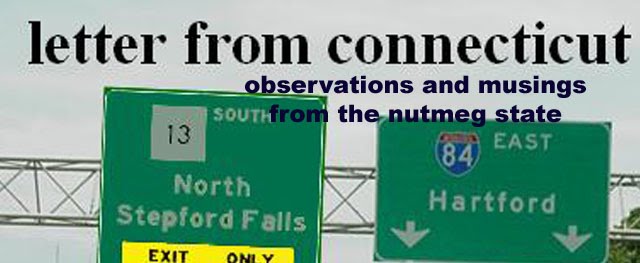
As for the art on top of this page: No, it's not real. North Stepford Falls is not on any map, not any more than its more wealthy and troubled neighbor; it's everywhere and nowhere, simultaneously. Maybe I can show you where to find it...
Excerpt: Pressfield, Steven. The War Of Art. New York: Grand Central Publishing, 2003.
I am a writer. It's what I was born to do and what I do better than anything else -- better than my mad Iron Chef skillz, my jumpshot or my electric guitar tone. And the more I vent about not being a full-time writer, the more I realize that duh, there's nothing stopping you from writing on your own, friend.
Then a former colleague of mine started a blog despite the fact she finds time to be a Ph.D candidate despite a full-time job and a family.
Hey, I thought, I should do that.
And then it dawned on me: Hey, dummy, you already have a blog. In fact, you have three. One for the girl, one for writing about music and one catch-all "observations and musings from the Nutmeg State" scratchpad, all three of which have been collecting cobwebs for years while you frittered and wasted the hours in an offhand way.
So what will I try to do? After all, this has been tried before. And it didn't get far. No, it didn't get far.
Because for a writer, I've grown pretty adept at either NOT writing or starting writing and not finishing. I've got one 50,000-word start of a manuscript about the inner lives of Seussian characters done and waiting for copious edits and needed improvements, 25,000 words of career-inspired early 90s rant collecting dust, a third idea waiting for NaNoWriMo in November and a fourth and a fifth kicking about in my brain.
The answer? Just write, really.
In his brilliant work on getting to work, "The War Of Art," Steven Pressfield gives the inability to do things you've always wanted to do a name: Resistance. And how do we overcome resistance? By sitting down and getting to work, he says. Stop procrastinating and waiting for tomorrow; do it today.
I've oversimplified a great deal. But here's a quick excerpt that gets to the heart of it:
Have you ever brought home a treadmill and let it gather dust in the attic? Ever resolved on a diet, a course of yoga, a meditation practice? Have you ever felt a call to embark upon a spiritual practice, dedicate yourself to a humanitarian calling, commit your life to the service of others? Have you ever wanted to be a mother, a doctor, an advocate for the weak and helpless; to run for office, crusade for the planet, campaign for world peace or to preserve the environment? Late at night have you experienced a vision of the person you might become, the work you could accomplish, the realized being you were meant to be? Are you a writer who doesn't write, a painter who doesn't paint, an entrepreneur who never starts a venture? Then you know what Resistance is.
So I'm going to just write.
Here, I think I'll write about pretty much anything Nutmeggy, and some things that are not limited to this state -- even "third rail" topics like politics and faith. Whatever crosses my path or my mind. Connecticut is a strange and confusing state and if you asked me 10 years ago, I would have told you I never expected to live here. But here I am. As the first entry in this blog years ago noted, the state motto is Qui transtulit sustinet, translated from Latin as "he who is transplanted still sustains," and Connecticut has sustained us for the past five years. It's an interesting place. And it's home.
As for the art on top of this page: No, it's not real. North Stepford Falls is not on any map, not any more than its more wealthy and troubled neighbor; it's everywhere and nowhere, simultaneously. Maybe I can show you where to find it...
Excerpt: Pressfield, Steven. The War Of Art. New York: Grand Central Publishing, 2003.
Subscribe to:
Posts (Atom)